Prayer Power Global Ministries

The Names of
God

And what each one means · Free to print

The Hebrew names of God, what each one means, and where it appears in Scripture, so you can know Him by name and pray His names back to Him.

Pray His names back to Him.

Two printable guides. No email and no sign-up.

Read them below

Why God has so many names

In the Bible, a name is more than a label. It tells you something true about who someone is. So when God reveals a new name, it is usually because someone needed to know that part of Him: Hagar alone in the desert, Abraham on the mountain, Gideon hiding and afraid.

The biblical names of God below are the main Hebrew names and the covenant names formed with Yahweh. Each one comes with its meaning in plain English, where it first appears in Scripture, and what it can mean for you. Knowing God by name is one of the oldest ways to know Him, and praying His names back to Him is one of the oldest ways to pray.
אֱלֹהִים

Elohim: God, the Creator

Elohim is the first name for God in the Bible and the most common Hebrew word for God in the Old Testament. It speaks of His power and majesty as Creator. The form is plural, but it is used with singular verbs for the one true God.

In the beginning God created the heavens and the earth.

Genesis 1:1 · NIV

אֵל שַׁדַּי

El Shaddai: God Almighty

El Shaddai means God Almighty. God gave this name to Abram when he was ninety-nine and still waiting on a promise that looked impossible. The exact root of Shaddai is debated by scholars, but its meaning in Scripture is clear: the God who is more than enough, and able to do what He said.

When Abram was ninety-nine years old, the LORD appeared to him and said, “I am God Almighty; walk before me faithfully and be blameless.

Genesis 17:1 · NIV

אֲדֹנָי

Adonai: Lord, Master

Adonai means Lord or Master, and it speaks of God’s authority and His right to rule. When your Bible prints “Lord” with ordinary lowercase letters, the Hebrew behind it is often Adonai. In Psalm 8:1 you can see both names side by side: “LORD” is Yahweh, and “our Lord” is Adonai.

LORD, our Lord, how majestic is your name in all the earth! You have set your glory in the heavens.

Psalm 8:1 · NIV

Also in Genesis 15:2, where Abram calls Him “Sovereign LORD” (Adonai Yahweh)

יהוה

Yahweh: the LORD, I AM

Yahweh is God’s personal, covenant name, the name He gave Moses at the burning bush. It is connected to the Hebrew verb “to be”: He is the One who simply and eternally is. English Bibles usually print it as LORD in capital letters.

Why do some Bibles say Jehovah? Hebrew was first written without vowels, so the name appears as four letters, YHWH. Out of reverence, Jewish readers said Adonai instead of pronouncing it, and scribes added Adonai’s vowel marks to the four letters as a reminder. Later Christian readers combined the two, and the result in English was Jehovah. Jehovah and Yahweh are the same name; Yahweh is generally thought closer to the original sound.

God said to Moses, “I AM WHO I AM. This is what you are to say to the Israelites: ‘I AM has sent me to you.’”

Exodus 3:14 · NIV

Also in Exodus 3:15 and Psalm 83:18 (KJV), one of the few verses where the King James prints “JEHOVAH”

יְהוָה יִרְאֶה

Jehovah Jireh: The LORD Will Provide

Abraham gave this name to the mountain where God provided a ram in place of his son Isaac. The Hebrew word jireh literally means “will see,” so the name carries the sense that the LORD sees ahead and sees to it. He knows what you need before you get there.

So Abraham called that place The LORD Will Provide. And to this day it is said, “On the mountain of the LORD it will be provided.”

Genesis 22:14 · NIV

יְהוָה רֹפְאֶךָ

Jehovah Rapha: The LORD Who Heals

If you are looking for the name of God for healing, this is it. God revealed Himself as the LORD who heals just after He made bitter water sweet for His thirsty people in the wilderness. He heals bodies, hearts and lives, in His wisdom and His timing.

for I am the LORD, who heals you.

Exodus 15:26 · NIV

יְהוָה נִסִּי

Jehovah Nissi: The LORD Is My Banner

After a battle against the Amalekites, Moses built an altar and gave it this name. A banner was the flag an army rallied around. To call God your banner is to say that your victory, your identity and your safety are found in Him.

Moses built an altar and called it The LORD is my Banner.

Exodus 17:15 · NIV

יְהוָה שָׁלוֹם

Jehovah Shalom: The LORD Is Peace

Gideon was hiding, afraid and sure he was about to die when God met him and said, “Peace!” Gideon built an altar and named it this. Shalom is more than the absence of conflict. It means wholeness, and God does not only give it; He is it.

So Gideon built an altar to the LORD there and called it The LORD Is Peace.

Judges 6:24 · NIV

יְהוָה רֹעִי

Jehovah Raah: The LORD Is My Shepherd

Also written Jehovah Rohi. David, who had been a shepherd himself, knew what the job involved: guiding, feeding, protecting, and going after the one that wandered off. This is the name behind the best-known psalm in the Bible.

The LORD is my shepherd, I lack nothing.

Psalm 23:1 · NIV

יְהוָה צִדְקֵנוּ

Jehovah Tsidkenu: The LORD Our Righteousness

Jeremiah gave this name to a coming King from David’s line, a promise Christians see fulfilled in Jesus. Many translations render it “The LORD Our Righteousness”; the NIV has “The LORD Our Righteous Savior.” Either way, it means our right standing with God is His gift, not our achievement.

Also in Jeremiah 23:6 and 33:16

יְהוָה שָׁמָּה

Jehovah Shammah: The LORD Is There

These are the last words of the book of Ezekiel, given as the new name of the restored city of God. Ezekiel had watched God’s glory leave the temple. This name is the promise that He will come back and stay.

Also in Ezekiel 48:35

יְהוָה צְבָאוֹת

Jehovah Sabaoth: The LORD of Hosts

Sabaoth means armies or hosts, so the Lord of hosts meaning is the Commander of heaven’s armies, sovereign over every power in heaven and on earth. The King James says “LORD of hosts”; the NIV usually translates it “LORD Almighty.” It first appears in 1 Samuel 1:3, in the story of Hannah, who prayed to Him for a son.

The LORD Almighty is with us; the God of Jacob is our fortress.

Psalm 46:7 · NIV

אֵל רֳאִי

El Roi: The God Who Sees Me

Sometimes written Elroi. Hagar was a servant who had been mistreated and had run away into the desert, pregnant and alone. God found her there, and she gave Him this name. If you feel invisible, El Roi sees you.

She gave this name to the LORD who spoke to her: “You are the God who sees me,” for she said, “I have now seen the One who sees me.”

Genesis 16:13 · NIV

אֵל עֶלְיוֹן

El Elyon: God Most High

Melchizedek, priest of God Most High, blessed Abram by this name after a battle and called Him Creator of heaven and earth. El Elyon means there is no power above Him, no authority He answers to, and nothing outside His reach.

Also in Genesis 14:18–20 and Psalm 91:1

אֵל עוֹלָם

El Olam: The Everlasting God

Abraham planted a tree at Beersheba and called on the LORD by this name; the NIV translates it “the Eternal God.” He has no beginning and no end. Whatever season you are in, He was there before it began and will be there after it ends.

Also in Genesis 21:33 and Isaiah 40:28

אַבָּא

Abba: Father

Abba is the Aramaic word for father. Jesus prayed it in Gethsemane on the night before the cross (Mark 14:36). It is often said to mean “daddy,” but it was also what grown children called their fathers: warm and close, yet full of respect. Through the Spirit, God invites you to call Him the same thing.

Because you are his sons, God sent the Spirit of his Son into our hearts, the Spirit who calls out, “Abba, Father.”

Galatians 4:6 · NIV

Also in Romans 8:15

עִמָּנוּ אֵל

Immanuel: God With Us

Isaiah promised a child who would be called Immanuel, and Matthew tells us the promise was kept in Jesus. Immanuel meaning “God with us” is the heart of the Christmas story, and the heart of the whole Bible: God did not stay far away.

“The virgin will conceive and give birth to a son, and they will call him Immanuel” (which means “God with us”).

Matthew 1:23 · NIV

Also in Isaiah 7:14

Names of Jesus

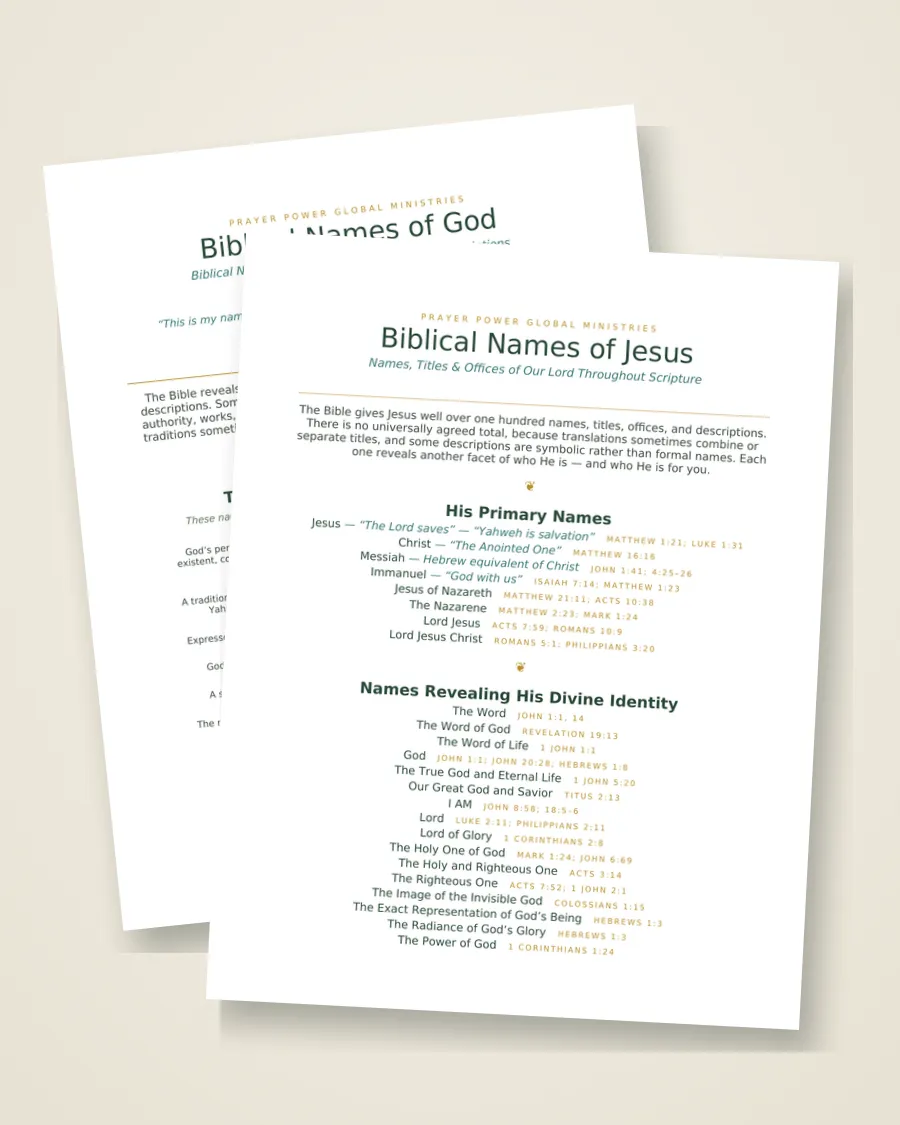
Jesus is given well over a hundred names and titles in Scripture. Here are seven to begin with. The free Biblical Names of Jesus (free PDF download) guide has the rest, with references.

Matthew 1:21

Jesus

From the Hebrew Yeshua, “the LORD saves.” The angel told Joseph to give Him this name because He would save His people from their sins.

Matthew 16:16 · John 1:41

Christ, the Messiah

Christ (Greek) and Messiah (Hebrew) both mean the Anointed One, the King God promised.

John 1:1, 14

The Word

God speaking Himself into the world. The Word was with God, was God, and became flesh.

John 1:29

Lamb of God

John the Baptist’s name for Him: the one sacrifice that takes away the sin of the world.

John 10:11

The Good Shepherd

The shepherd of Psalm 23 in person, who lays down His life for the sheep.

John 8:58

I AM

Jesus took God’s own name from the burning bush and applied it to Himself.

Isaiah 9:6

Prince of Peace

One of four names Isaiah gave the promised child, alongside Wonderful Counselor, Mighty God and Everlasting Father.

The printed Names of God and Names of Jesus guides resting on linen

Two printable guides, free to keep, study and share. No email required.

If you would like the next one

Sheila Renae writes a new prayer or teaching most weeks. If you would like it sent to you, leave your email here. Nothing else comes with it, and you can stop whenever you want.

The guides above are yours either way.

Knowing God by name

The names of God are not trivia. Each one was revealed inside a real story, to a real person in a real need, and the best way to learn them is to read those stories for yourself.

Read: Finding Strength, Truth and Connection in God’s Word

Read: Core Principles of the Christian Faith

Scripture quotations taken from The Holy Bible, New International Version®, NIV®. Copyright © 1973, 1978, 1984, 2011 by Biblica, Inc.™ Used by permission. All rights reserved worldwide.