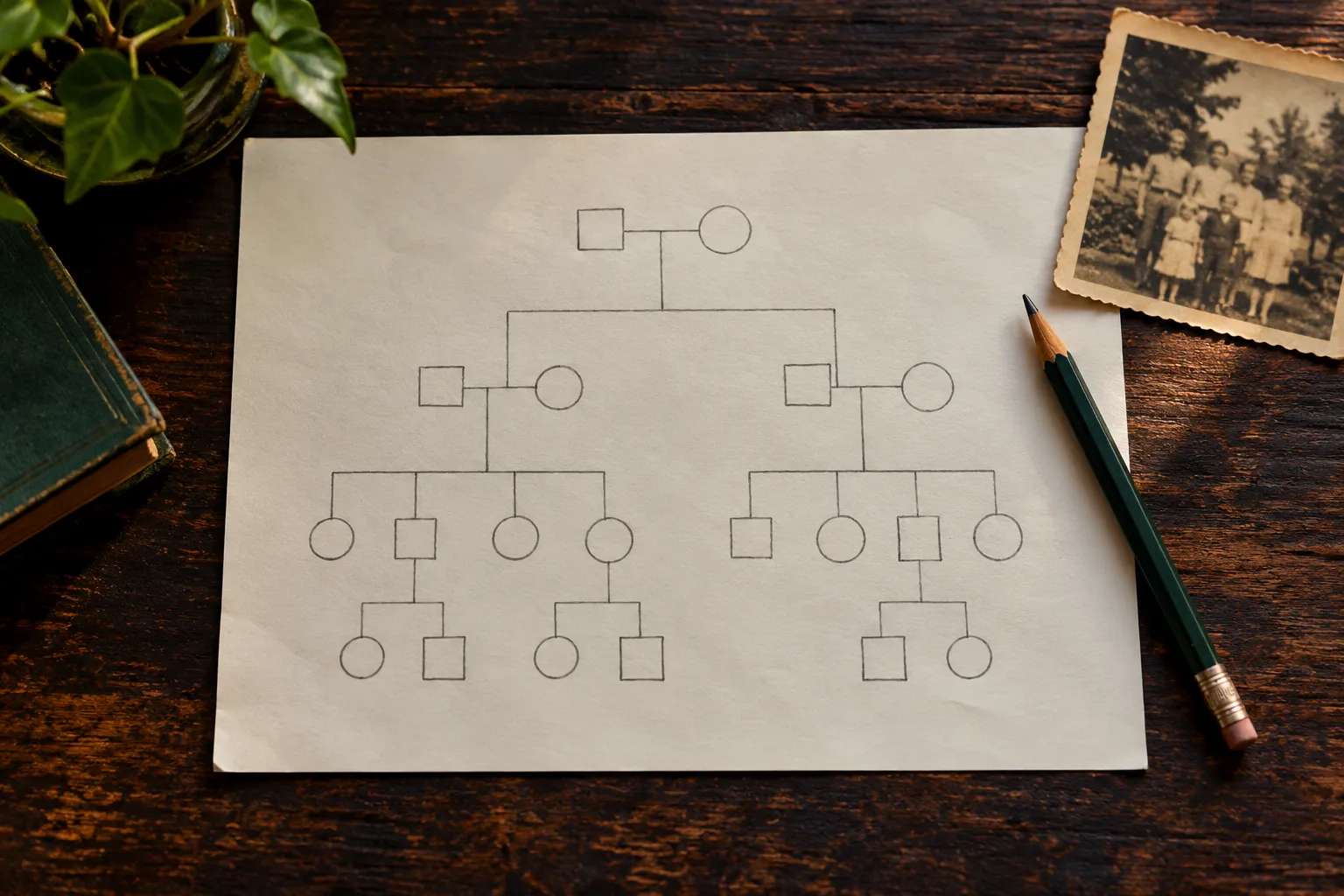
Take a blank sheet of paper and a pencil. Draw a shape for your grandfather and one for your grandmother, joined by a line. Drop a line to your mother or father, then one more to you.
Now, beside each person, write one word for what they did when life got hard. Drank. Prayed. Left. Went quiet. Worked until midnight. Yelled.
Somewhere around the third generation, the pencil usually stops. The same word is sitting there twice. That page is where family patterns, generational trauma and prayer meet. On paper, in pencil, in your own handwriting.
That small drawing is called a genogram. Generational patterns are the heart of my Echoes of Eden book and course, and this is one of the simplest ways I know to begin.
I did not find my own patterns with a pencil. My body found them first. Through my own growth journey I learned that my body was hiding traumatic memories, and that somatic holding had transferred into physical pain. And underneath my pain was the resounding message I heard throughout my childhood: that I didn't matter.
If you'd like a softer first step, our free generational patterns quiz and reflection tools are a good place to begin.
Every Family Tree Has a Bend in It
Scripture is honest about inheritance. When the Lord passed before Moses on the mountain, He named Himself merciful and gracious, and then He said this:
...visiting the iniquity of the fathers upon the children, and upon the children's children, unto the third and to the fourth generation.
— Exodus 34:7
The Hebrew word translated iniquity is ʿāwōn. It comes from the root ʿāwāh, which means to bend or to twist. Not a stain. A bend. Something grows crooked in one generation, and the next branch grows out of the crooked place without ever choosing to.
And notice what the same verse says first: the Lord is "keeping mercy for thousands." Thousands, set against three or four.
A bend is not a verdict on you. Generations later, the prophets corrected a proverb people used to explain their lives:
In those days they shall say no more, The fathers have eaten a sour grape, and the children's teeth are set on edge.
— Jeremiah 31:29
So both are true. Patterns pass down. And you are not condemned to repeat them. I've written before about identifying and healing generational trauma; a genogram puts your own family's names on the page. The question on that page isn't "What's wrong with my family?" It's this one: where is the bend, and what would it look like to grow straight from here?
Genesis Is a Genogram
Read Genesis slowly, with a pencil in your hand, and you can watch one lie travel four generations.
Abraham, afraid for his life, told a king that Sarah was his sister. He did it twice (Genesis 12 and 20). His son Isaac went to the same place, Gerar, and told the same lie about Rebekah (Genesis 26).
Isaac's son Jacob let his mother dress him in his brother's clothes and wrap goatskins on his hands, and he deceived his blind father (Genesis 27). Years later, Jacob's own sons killed a goat, dipped Joseph's coat in its blood, and deceived their father (Genesis 37).
A goat both times. There it was. The tell.
Even Joseph nearly carries it on, and I understand why. He hides who he is from his brothers, tests them, slips a silver cup into a sack. And then he can't keep it up. He weeps so loudly that Pharaoh's house hears him, and he tells the truth: "I am Joseph" (Genesis 45:3).
But as for you, ye thought evil against me; but God meant it unto good, to bring to pass, as it is this day, to save much people alive.
— Genesis 50:20
The bend stopped with one man who finally told the truth.
So here is the question I'd ask you to sit with. Not whether your family has a pattern. Every family does. Which negative one are you still repeating because nobody above you ever stopped?
The Science of Inheritance and the Spirit of Healing
Surface understanding has never been enough for me. I need to INNERSTAND things, to know them from the inside out. For my heart and head to get it equally.
Hard childhoods are not rare. In CDC survey data from 2011 to 2020, nearly two thirds of U.S. adults reported at least one adverse childhood experience, and one in six reported four or more (CDC, MMWR, 2023). If your tree holds hard things, you are not the exception.
Researchers have also asked whether the effects of trauma pass from parent to child. Rachel Yehuda and Amy Lehrner describe measurable differences in some adult children of Holocaust survivors, and they are careful to add that studies in humans "have not yet demonstrated that the effects of trauma are heritable through non-genomic (epigenetic) mechanisms" (World Psychiatry, 2018). Parenting, family stories and our own choices all get tangled together. So I won't tell you your pain is written in your genes. What I will tell you is that you don't have to know exactly how a pattern traveled to bring it to God.
A 2019 study of 6,188 Wisconsin adults found that those who recalled six or seven positive childhood experiences, like an adult who took a genuine interest in them or a family that stood by them in hard times, had 72% lower odds of depression or poor mental health than those who recalled two or fewer. That held even for people who also carried painful experiences (JAMA Pediatrics, 2019). It shows a link, not proof of cause. But it points where Scripture points. What is good in the tree gets passed down too.
No matter how or where our pain comes from, the answer is always Jesus. He is our hope.
How to Pray Over Family Patterns and Generational Trauma
You need paper, a pencil, an open Bible, and an hour when no one needs you.
1. Draw Three Generations, Gaps and All
Use a simple shape for each person and lines to connect them. Draw what you know. If you were adopted, if a parent was absent, if a whole side of the family is blank, draw a question mark and leave it there. A question mark is honest. God is not waiting for a finished chart before He will meet you.
2. Name the Patterns, Not the People
Beside each person, write what they did with pain: drinking, silence, rage, leaving, overworking, worry, secrets. Write the pattern, not a statement on the persons nature.
3. Mark the Faithfulness in Gold
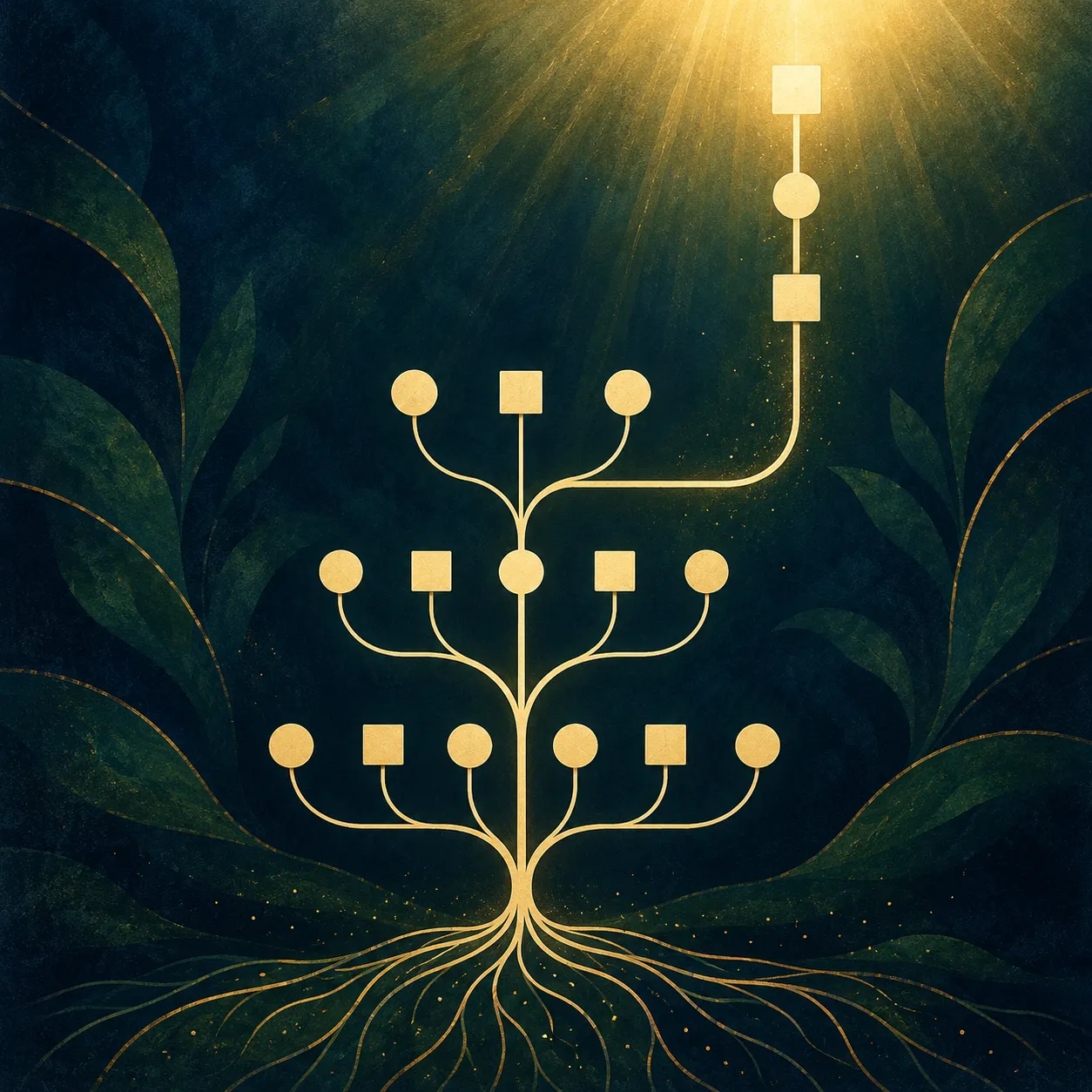
Then go back with a different color, your favorite color, and mark what was good. The aunt who prayed. The grandfather who never missed a day of work. Those lines are your inheritance too.
4. Pray Over One Line at a Time
Don't pray over the whole tree at once. Choose one pattern on one line, and open to Psalm 139:
Search me, O God, and know my heart: try me, and know my thoughts: And see if there be any wicked way in me, and lead me in the way everlasting.
— Psalm 139:23–24
Then pray something like this:
Lord, You see this line better than I do. I bring You the pattern that came down to me here. I don't carry it in shame, and I don't carry it alone. Show me where it lives in me, and teach me a straighter way to walk, so the ones after me inherit something different. In Jesus' name, amen.
If you want words to lean on, my Scripture-anchored prayers for daily struggles were written for exactly these moments.
5. Ask One Question With Teeth
Which pattern on this page do you defend? Not the one you hate. The one you explain, excuse, or call "just how we are." That one is usually the hardest, but the one to pray over first. Then tell one person you trust what you found.
When the Tree Holds Abuse
Some trees hold things a pencil can barely write. Abuse. Addiction. Prison. A family member who died by suicide.
If drawing your tree brings back memories that flood you, put the pencil down. Breathe, and ask Jesus to be with you: Jesus, stay with me. Then tell someone, a trusted friend.
If that doesn't feel like enough and you would like more direct help, reaching out to a licensed clinician or a crisis line is itself a faithful step, not a lack of faith. If you live in Michigan, Refreshing Waters Counseling & Consulting offers therapy; anywhere else, look for a licensed clinician near you. Prayer walks alongside that care. It never replaces it.
And if no one in your tree ever made you feel you belonged:
You are matter. Your place in His family does not depend on the one you were born into. I've written more on identity in Christ after trauma if that is the ground you need to stand on first.
Final Reflection
This is the verse that anchors our Ignite Encounter:
To appoint unto them that mourn in Zion, to give unto them beauty for ashes, the oil of joy for mourning, the garment of praise for the spirit of heaviness; that they might be called trees of righteousness, the planting of the LORD, that He might be glorified.
— Isaiah 61:3
Trees of righteousness. The planting of the Lord. The family tree you were handed is not the only tree you belong to.
I can't promise a pattern will lift on a schedule. I can promise you don't have to look at it alone. If you'd like someone to sit with you over your page, a one-on-one Ignite Encounter is sixty minutes of prayer and discernment together.
Tonight, start small. Draw three generations. Circle one word. Pray over that one line.
When you're ready for more, our free prayers, quizzes, and self-reflection tools are there for you. They're Scripture-anchored, and they cost nothing.
Blessings,
Sheila Renae
This article is for spiritual encouragement and education only. It is not medical or psychological advice, a diagnosis, or treatment, and it is not a substitute for care from a licensed professional. Prayer Power Ministries' encounters are ministry, not counseling or therapy. If you are struggling, please reach out to a licensed clinician — seeking help is itself a faithful step. If you are in crisis or immediate danger, call or text 988 or call 911.
About the Author
Sheila Renae Burns — Founder · Prayer Power Global Ministries
Sheila is a counselor, author, speaker, and intercessor who is passionate about helping people heal from generational wounds, deepen their relationship with God, and walk in greater freedom. She writes with compassion, spiritual insight, and a deep belief that transformation is possible. Through her writing, Sheila invites readers into a journey of healing, hope, and Encounter with the God who restores what has been broken.